

More than half of women using multivitamin supplements reported improved skin health in recent user studies, yet the beauty supplement aisle still feels overwhelming. Can a daily multi actually give you glowing skin, stronger hair, and harder nails, or is it clever marketing? The answer sits somewhere between the two, and it depends heavily on what your body is actually missing. This article breaks down the real science, the honest caveats, and the practical steps so you can decide whether a multivitamin deserves a spot in your beauty routine.
Table of Contents
- What are multivitamins and how do they relate to beauty?
- How multivitamins support skin health
- The impact of multivitamins on hair strength and growth
- The role of multivitamins in nail strength and overall beauty synergy
- When and who should use multivitamins: expert perspectives and caveats
- Real beauty starts from within: explore premium wellness and beauty solutions
- Frequently asked questions
Key Takeaways
| Point | Details |
|---|---|
| Clear beauty benefits | Over half of women notice real improvements in skin, hair, and nails from multivitamin use. |
| Best for dietary gaps | Multivitamins are most effective for women with nutritional deficiencies or restrictive diets. |
| Specific vitamins matter | Vitamins like C, A, E, and certain Bs have direct, proven roles in supporting beauty from within. |
| Balance and safety | Too much vitamin A or selenium may harm rather than help—always follow recommended doses. |
What are multivitamins and how do they relate to beauty?
A multivitamin is a single supplement that combines several essential vitamins and minerals in one dose. Most formulas include vitamins A, C, E, the B-complex group, and key minerals like zinc, selenium, and iron. These are not luxury nutrients. They are the raw materials your body uses every single day to build and repair tissue, including your skin, hair follicles, and nails.
The connection to beauty is direct. Vitamins A, C, E, and B vitamins support skin health through antioxidant activity, anti-inflammatory pathways, collagen synthesis, and barrier function. When any of these nutrients run low, your appearance often shows it first. Dull skin, shedding hair, and peeling nails are classic early signs of nutritional gaps. You can explore the full breakdown in our beauty-enhancing vitamins guide.
| Vitamin | Key function | Visible beauty effect |
|---|---|---|
| Vitamin A | Cell turnover, sebum regulation | Smoother skin, less breakout |
| Vitamin C | Collagen synthesis, antioxidant | Brighter tone, firmer skin |
| Vitamin E | Membrane protection, hydration | Softer skin, reduced redness |
| B vitamins | Energy metabolism, keratin support | Stronger hair and nails |
| Zinc | Wound healing, oil control | Clearer skin, less inflammation |
Top reasons women turn to multivitamins for beauty:
- Busy schedules make a consistently nutrient-rich diet hard to maintain
- Restrictive diets (vegan, low-calorie) create predictable gaps
- Stress depletes B vitamins and vitamin C faster than food replaces them
- Aging reduces the skin’s ability to synthesize and use certain nutrients efficiently
- A single daily supplement is far simpler than managing five separate bottles
How multivitamins support skin health
Your skin is your body’s largest organ, and it is also the most visible indicator of what is happening inside. Free radicals, which are unstable molecules from sun exposure, pollution, and stress, break down collagen and accelerate aging. Antioxidants in multivitamins, particularly vitamins C and E, neutralize those free radicals before they cause lasting damage.
Vitamin C does double duty. It fights oxidative stress and directly stimulates collagen production, the protein that keeps skin firm and plump. Vitamin E works alongside it to protect cell membranes and lock in moisture. Vitamin A accelerates cell turnover, which means fresher, more even-toned skin rising to the surface faster. Learn how B vitamins for skin vitality round out this picture with energy support at the cellular level.
The research backs this up. Multivitamin supplementation increased skin carotenoids, vitamin C, and selenium levels and improved self-reported skin health and quality of life in clinical studies. That is not a small finding. It means the nutrients are actually reaching the skin and making a measurable difference.
“Specific vitamins, particularly C, E, and A, have the strongest evidence for supporting skin structure and reducing visible signs of aging when dietary intake is insufficient.” — dermatology nutrition research consensus
Top three visible skin benefits from multivitamins:
- More even, brighter skin tone from increased antioxidant activity
- Improved hydration and barrier strength from vitamins A and E
- Reduced inflammation and redness, especially in stressed or hormonally active skin
Pro Tip: When choosing a multi for skin, look for one that lists vitamin C as ascorbic acid and vitamin E as d-alpha-tocopherol. These are the most bioavailable (easily absorbed) forms, meaning your skin actually gets the benefit. Check out our picks for top supplements for skin glow to see which formulas make the cut.
The impact of multivitamins on hair strength and growth
Hair growth is a surprisingly nutrient-hungry process. Each follicle cycles through growth, transition, and rest phases, and every stage depends on a steady supply of vitamins and minerals. When your body is short on key nutrients, it redirects resources away from hair, which is considered non-essential, toward vital organs first. The result is increased shedding, slower growth, and thinner strands.

Multivitamins improve hair density, thickness, and quality in women with thinning hair or nutritional deficiencies, working through keratinization (the process of building the hair’s protein structure), metabolic support, and antioxidant protection. Biotin is the most talked-about hair vitamin, but it works best alongside the full B-complex, vitamin C for scalp circulation, and vitamin A for healthy sebum production. Our guide to top hair health vitamins explains each one in detail.
How nutrients support each stage of hair growth:
- Anagen (active growth): B vitamins and iron fuel rapid cell division in the follicle
- Catagen (transition): Antioxidants from C and E protect follicle cells from stress-related damage
- Telogen (rest/shedding): Zinc and vitamin D help regulate the shift back into active growth
- Exogen (release): Adequate protein metabolism, supported by B6 and B12, keeps shedding within normal range
| Feature | Standard multivitamin | Targeted nutraceutical (e.g., Nutrafol) |
|---|---|---|
| Nutrient range | Broad, general | Narrow, hair-focused |
| Dosage | Maintenance level | Therapeutic level |
| Cost | Low to moderate | High |
| Best for | Filling general gaps | Diagnosed deficiency or significant thinning |
| Evidence base | Moderate, general wellness | Growing, hair-specific trials |
Research on nutraceuticals for hair growth shows that targeted formulas can outperform standard multis for women with clinically significant thinning. But for most women with mild gaps, a quality multi is a smart, affordable starting point. Explore more in our deep dives on hair growth secrets and micronutrients for healthy hair.
Pro Tip: More is not always better. Excess vitamin A (above 10,000 IU daily from supplements) and high-dose selenium can actually trigger hair loss rather than prevent it. Always check your multi’s label and avoid stacking multiple supplements with overlapping high-dose nutrients.
The role of multivitamins in nail strength and overall beauty synergy
Nails grow slowly, about 3 millimeters per month, which makes them a reliable long-term indicator of nutritional status. Brittle nails that peel, crack, or grow unevenly often signal low biotin, iron, or zinc. Biotin and vitamin C have the strongest evidence for nail strength, and both are standard inclusions in quality multivitamin formulas.
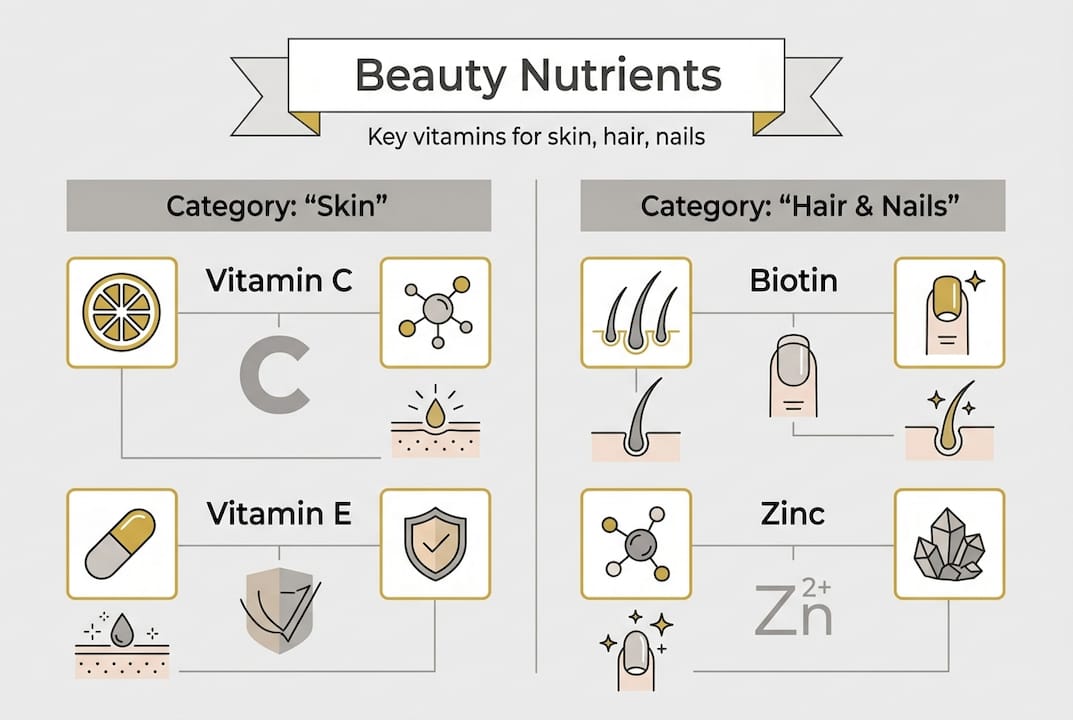
The real power of a multivitamin for beauty is its synergy. Skin, hair, and nails all rely on overlapping nutrients. Vitamin C supports collagen in both skin and the nail bed. Zinc regulates oil production in skin and supports keratin in nails. B vitamins fuel the cellular energy that drives all three. You can explore targeted options in our guides to beauty supplements for hair and nails and supplement for nails.
Who benefits most from multivitamins for beauty:
- Women following vegan or plant-based diets (low in B12, iron, zinc)
- Those with high-stress lifestyles that deplete water-soluble vitamins quickly
- Anyone eating fewer than 1,600 calories daily due to dieting
- Women in their 30s and 40s whose nutrient absorption naturally declines
- Those with irregular eating patterns or limited food variety
53% of women reported improved complexion and skin health from multivitamin supplementation in user studies. That is a meaningful number, but it also means nearly half did not notice a visible difference. Context matters. Multivitamins are most effective for filling gaps in women with deficiencies, not as a universal beauty upgrade.
Pro Tip: Track your nail growth rate and texture in a simple phone note when you start a new supplement. Nails often show improvement before skin or hair because the growth cycle is more predictable. Visible changes in 6 to 8 weeks are a good early signal that the nutrients are working. Pair your supplement with a consistent morning wellness beauty routine for the best results.
When and who should use multivitamins: expert perspectives and caveats
Not every woman needs a multivitamin, and the research is honest about that. If your diet is genuinely varied and balanced, a multi may add little visible benefit. The evidence is clearest for women who have confirmed or likely nutritional gaps.
“Multivitamins are best used as a nutritional safety net, not a replacement for a healthy diet. For women with dietary restrictions or high physiological demands, they can make a real, visible difference.” — Women’s Health nutrition advisory
Experts note multivitamins are unnecessary for balanced diets and are most valuable for filling gaps in women with deficiencies. The nuance is important. A multi is a tool, not a cure.
Women who benefit most from multivitamins:
- Vegans and vegetarians missing B12, iron, and zinc from animal sources
- Women with chronic stress or poor sleep, which rapidly depletes B vitamins and vitamin C
- Those with confirmed deficiencies identified through blood work
- Women over 35 whose digestive absorption of certain nutrients declines with age
- Anyone recovering from illness, surgery, or a period of poor nutrition
Dermatologists recommend multis primarily for deficiencies, and the empirical data is stronger for specific vitamins like biotin and C than for broad-spectrum multis. This means if you have a specific concern, like thinning hair or brittle nails, a targeted single supplement may outperform a general multi. Our vitamins guide for beauty and beauty supplements guide can help you figure out which approach fits your situation.
The bottom line is simple. Eat well first. Supplement strategically second. And always read the label before stacking multiple products.
Real beauty starts from within: explore premium wellness and beauty solutions
Now that you understand how vitamins work from the inside out, the next step is finding products that actually deliver the right nutrients in the right forms. Not all supplements are created equal, and the difference between a budget multi and a premium formula often comes down to bioavailability and ingredient quality.
At Lumieve Glow, we formulate with exactly that in mind. Our Beauty + Collagen Strips are designed for women who want targeted, convenient nutrition that fits into a real daily routine, no pills, no guesswork. If you are ready to build a complete inside-out approach, our full range of wellness supplements covers everything from skin-focused antioxidants to hair and nail support, all lab-tested and crafted for women who take their glow seriously. Your routine deserves ingredients that work as hard as you do.
Frequently asked questions
What vitamins in a multivitamin support beauty?
Vitamins A, C, E, and B vitamins are the core beauty nutrients, supporting skin through antioxidant protection, collagen production, and barrier repair, while also fueling hair and nail growth.
How long until I see beauty results from a multivitamin?
Most women notice visible changes in skin tone or hair texture within 2 to 3 months of consistent daily use, with 53% reporting improved skin health in user studies.
Are multivitamins really necessary for beauty?
Experts say multivitamins are unnecessary if your diet is already balanced and varied, but they are genuinely helpful for filling gaps caused by dietary restrictions or high-stress lifestyles.
Can too many vitamins harm my hair or nails?
Yes. Excess vitamin A and selenium can trigger hair loss or cause brittle nails, so always check dosages before combining multiple supplements.
Is a multivitamin better than single vitamin supplements for beauty?
Dermatologists find specific vitamins like biotin and C more effective for targeted concerns, while multis are the smarter choice when you need to address several nutritional gaps at once.
