

TL;DR:
- A simple, consistent skincare routine with a few key products can improve skin results.
- Applying products from thinnest to thickest and using SPF daily are essential steps.
- Focus on patience and routine consistency rather than complicated or trendy regimens.
You don’t need a shelf full of products or a 12-step regimen to get glowing skin. The beauty industry loves to make skincare feel complicated, but the truth is that a focused, consistent routine built around a few well-chosen products can deliver real, visible results. Whether you’re starting from scratch or trying to simplify what you already have, this guide covers everything you need: what a skincare routine actually is, which steps matter most, how to pick the right products for your skin, and which common myths are quietly sabotaging your progress.
Table of Contents
- What is a skincare routine?
- Core steps of an effective skincare routine
- Choosing the right products for your skin
- Skincare routine myths and what really works
- Why simplicity and consistency beat the hype
- Find your skincare essentials with LUMIEVE
- Frequently asked questions
Key Takeaways
| Point | Details |
|---|---|
| Routine basics matter | Regular cleansing, moisturizing, and sun protection are the foundation of effective skincare. |
| Consistency wins | Sticking to a routine yields more visible, lasting results than using trendy or expensive products sporadically. |
| Tailor to your skin | Choose products and steps that suit your skin type and needs for optimal benefits. |
| Avoid overcomplication | Simple routines are proven to be both effective and easier to sustain long term. |
What is a skincare routine?
A skincare routine is a set of regular steps you follow to cleanse, nourish, and protect your skin. That’s it. No complicated formulas, no mandatory 10-step rituals. At its core, a routine is about giving your skin what it needs, consistently, so it can function at its best.
Your skin is your body’s largest organ, and it works hard every day. It protects you from environmental stress, regulates temperature, and acts as a barrier against pollutants and bacteria. A routine supports all of that by removing buildup, replenishing moisture, and shielding against damage.
Here’s what a basic routine typically includes:
- Cleanser: Removes dirt, oil, makeup, and environmental debris
- Moisturizer: Replenishes hydration and supports the skin barrier
- SPF (sunscreen): Protects against UV damage and premature aging
- Targeted treatments: Serums or spot treatments that address specific concerns like dullness, acne, or fine lines
The key insight most people miss? Consistency matters far more than complexity. Using three products every single day will outperform a 10-product routine you abandon after two weeks. Simple skincare routines can genuinely improve skin radiance and overall wellness without requiring a major time or financial investment.
“The best skincare routine is the one you’ll actually stick to. Simplicity isn’t a shortcut. It’s the strategy.”
When you strip away the noise, skincare becomes less about buying more and more about understanding what your skin actually needs. A routine creates a repeatable framework that lets your skin adapt, recover, and thrive over time. Think of it like sleep: one good night doesn’t transform you, but consistent, quality rest over weeks absolutely does.
Core steps of an effective skincare routine
With an understanding of what a skincare routine is, let’s explore the practical steps and how they vary throughout the day.
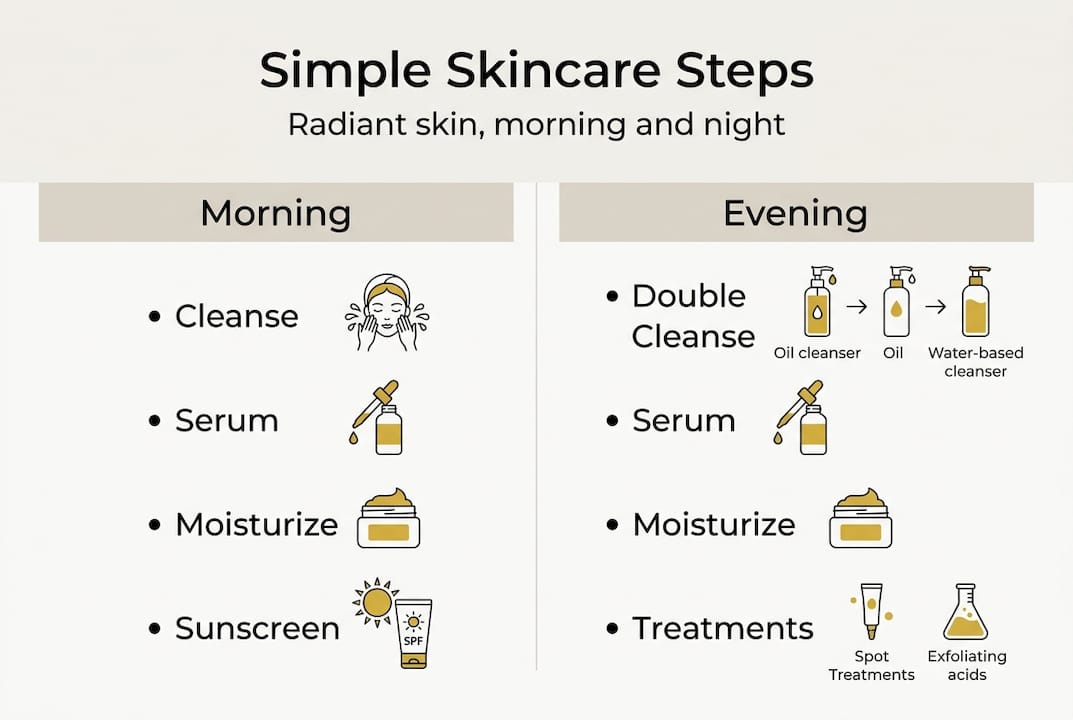
Your morning and evening routines serve different purposes. In the morning, the goal is to prep and protect. In the evening, it’s about repair and recovery. The products you use and the order you apply them both matter.
Morning routine steps:
- Cleanse (gentle wash to remove overnight buildup)
- Apply serum (vitamin C or antioxidant to brighten and defend)
- Moisturize (lock in hydration before the day begins)
- Apply SPF (non-negotiable, every single morning)
Evening routine steps:
- Double cleanse if wearing makeup (oil cleanser, then water-based cleanser)
- Apply treatment serum (retinol, niacinamide, or peptides)
- Moisturize (richer formula to support overnight recovery)
- Eye cream if needed (optional but helpful for the delicate under-eye area)
Here’s a quick comparison to keep it clear:
| Step | Morning | Evening |
|---|---|---|
| Cleanse | Light, gentle wash | Double cleanse if needed |
| Serum | Vitamin C or antioxidant | Retinol or repair serum |
| Moisturizer | Lightweight formula | Richer, nourishing formula |
| SPF | Always apply | Skip (no sun exposure) |
| Treatment | Optional brightening | Active treatments |
A basic routine built around cleansing, moisturizing, and sun protection covers the essentials for most skin types. From there, you layer in targeted treatments based on your specific goals.

Pro Tip: Apply sunscreen every morning, even on cloudy days or when you’re working indoors. UV rays penetrate windows and clouds, and daily SPF use is one of the most proven ways to prevent premature aging.
Order matters too. As a general rule, apply products from thinnest to thickest consistency. Serums go before moisturizers, and moisturizers go before SPF. This ensures each product absorbs properly rather than sitting on top of another layer and losing effectiveness. Explore easy skincare solutions if you want more guidance on building a routine that fits your lifestyle.
Choosing the right products for your skin
Knowing the steps, let’s turn to how you select the best products to match your skin’s unique needs.
Not all products work for all skin types. Using the wrong formula, even a high-quality one, can trigger breakouts, dryness, or irritation. The first step is identifying your skin type:
- Oily skin: Prone to shine and enlarged pores; benefits from lightweight, non-comedogenic (won’t clog pores) formulas
- Dry skin: Feels tight or flaky; needs richer moisturizers and hydrating serums
- Combination skin: Oily in the T-zone (forehead, nose, chin) but dry elsewhere; requires a balanced approach
- Sensitive skin: Reacts easily to fragrances, actives, or harsh ingredients; needs gentle, minimal formulations
Once you know your skin type, match your product categories accordingly. Product choice should always reflect your skin type and specific concerns rather than what’s trending.
Hydration is one area where the science is clear. Proper hydration is central to skin radiance, and studies suggest it can boost skin’s luminosity by up to 50%. Hyaluronic acid is one of the most effective hydrating ingredients available because it draws moisture into the skin and holds it there.
Common product selection mistakes to avoid:
- Using too many active ingredients at once (this can cause irritation and actually slow progress)
- Choosing products based on price alone (expensive doesn’t always mean better)
- Skipping moisturizer if you have oily skin (oily skin still needs hydration)
- Ignoring how B vitamins for skin vitality can support your skin from the inside out alongside topical products
Pro Tip: Always patch test a new product before applying it to your full face. Apply a small amount to your inner arm or behind your ear and wait 24 hours. This simple step can save you from a full-face reaction.
Building a product lineup doesn’t have to be overwhelming. Start with the core three: cleanser, moisturizer, and SPF. Once your skin adjusts, add one targeted treatment at a time. Patience and simplicity win every time.
Skincare routine myths and what really works
Even with the right products and steps, many misconceptions still cloud the world of skincare routines.
The beauty industry thrives on complexity. More products, more steps, more spending. But a lot of what gets marketed as essential is actually unnecessary or even counterproductive. Let’s clear the air.
Common myths vs. what actually works:
- Myth: More products mean better results. Reality: Layering too many actives causes irritation and weakens the skin barrier.
- Myth: You need to follow the latest trending routine to see real improvement. Reality: Proven basics like SPF, hydration, and gentle cleansing outperform any trend.
- Myth: Natural ingredients are always safer. Reality: Some natural ingredients (like certain essential oils) are highly irritating, while some synthetic ingredients are extremely gentle and effective.
- Myth: If a product tingles, it’s working. Reality: Tingling often signals irritation, not efficacy.
- Myth: You only need SPF on sunny days. Reality: UV exposure happens year-round and indoors too.
What actually works is straightforward: correct product order, consistent application, and patience. A supplement workflow for radiant skin shows that consistency and correct product order matter far more than the number of products you use.
“Skin doesn’t respond to complexity. It responds to consistency. Give it what it needs, in the right order, every day.”
If you’ve been chasing results without seeing them, the fix is usually not a new product. It’s a more focused approach. A solid beauty supplement plan combined with a simple topical routine often delivers better results than any complicated multi-step regimen.
Why simplicity and consistency beat the hype
Here’s something the skincare industry doesn’t want you to internalize: the most transformative routines are usually the most boring ones. No viral 15-step rituals. No rotating cast of trending actives. Just a few well-chosen products, applied in the right order, every day without fail.
We’ve seen this pattern clearly. The people who get the most dramatic skin improvements aren’t the ones with the most products. They’re the ones who stick to simple solutions for clear skin and resist the urge to constantly switch things up.
Your skin has a natural renewal cycle of roughly 28 days. That means you need to give any new routine at least four to eight weeks before judging whether it’s working. Most people quit too soon, switch to something new, and never give their skin the chance to actually respond.
Pro Tip: Track your skin weekly, not daily. Daily changes are too subtle and can feel discouraging. Weekly check-ins give you a clearer picture of real progress.
Listen to your skin. If something causes persistent redness, breakouts, or tightness, scale back. Fewer products, used correctly and consistently, will always outperform a complicated routine you’re constantly second-guessing.
Find your skincare essentials with LUMIEVE
Ready to build a routine that actually works for your skin? At Lumieve Glow, we’ve made it easy to find exactly what your skin needs without the overwhelm.
Our skincare serums are formulated with high-quality, lab-tested ingredients designed to target specific concerns, from deep hydration to visible radiance. If you’re looking for a powerful hydration boost, our hyaluronic acid serum delivers moisture where your skin needs it most. For a convenient on-the-go treatment, our collagen strips are a simple addition to any routine. Every product is designed to integrate seamlessly into your daily life so you can stay consistent and see real results.
Frequently asked questions
How often should I follow my skincare routine?
Daily consistency, both morning and evening, provides the best results for long-term skin health. Consistent daily use leads to visible skin improvement over time.
Is it necessary to use all products in a routine every day?
Core steps like cleansing, moisturizing, and SPF are daily essentials, while treatments like retinol or exfoliants may be used a few times per week. A basic daily routine is effective for most skin types without needing every product every day.
Can I customize my routine for sensitive skin?
Absolutely. Tailor your product choices to avoid harsh fragrances, strong actives, and known irritants, and always patch test before applying anything new to your face. Choosing products based on your skin type is the most important step for sensitive skin.
How soon will I see results from a skincare routine?
Most people notice meaningful improvements within 4 to 8 weeks of consistent use. A glow-boosting routine typically produces visible results within 8 to 12 weeks when followed consistently.
